2025 in numbers
In 2025, BIO approved €235 M across 30 projects (up 25% from 22 approved projects in 2024) and signed 21 investments, reflecting strong demand, improved origination efficiency, and growing transaction complexity, while internal processes were strengthened to support timely execution. The year 2025 was marked by an increasingly diversified portfolio with a particular focus on Least Developed Countries (LDCs) and Fragile and Conflict-Affected States (FCAS), strong growth of direct investments focusing on agriculture and finally important progress on inclusion of decent work and human rights considerations in our investment process.
An increasingly diversified portfolio and a particular focus on LDCs
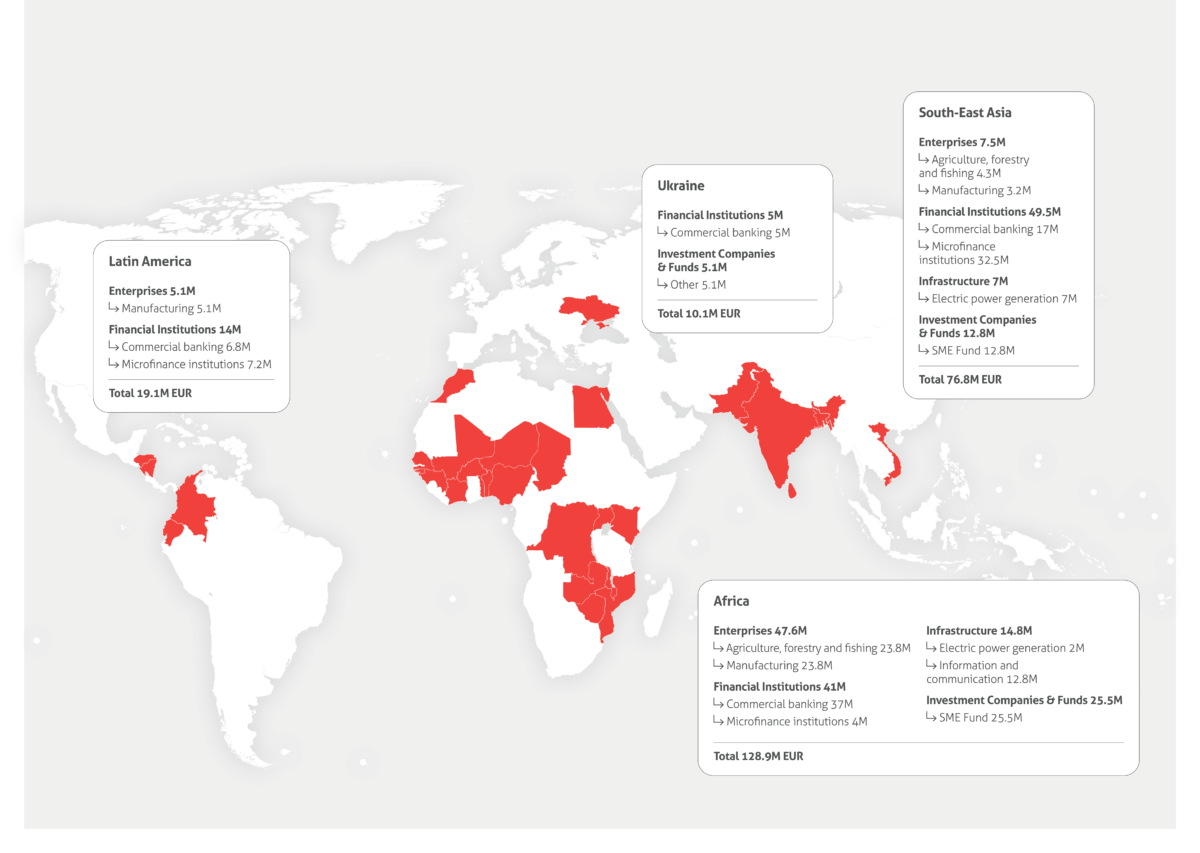
Geographically, approvals continued to reflect BIO’s commitment to fight inequality by investing in LDCs, FCS and Lower Income Countries (LICs). In the 2024-2025 period combined, 67% of capital subsidies (code 5 investments) and 33% of capital investments (code 8 investments) were allocated to those regions (against BIO’s Strategic Impact Targets (SITs) of 50% and 15% and an overall 30% as indicated in the investment strategy). BIO also acted upon its commitment to invest in Africa, which received 55% of approvals, more than the 45% objective. Other notable milestones included the approval of a second major investment in Ukraine and two investments in the Democratic Republic of Congo, illustrating BIO’s readiness to invest in FCS.
Strong growth of direct investments
Direct investments surged in 2025, with BIO approving 11 investments in enterprises—a sharp increase from just 2 the year before. This growth was driven primarily by investments in the agri-food value chain, including 'ECOM' (agricultural commodities), 'BIO Phyto' (organic fertilizer), and a renewed commitment to long-term client ‘La Laiterie du Berger’. BIO also expanded into the pharmaceutical sector with a new direct investment – ‘Orchidia’ in Egypt – and into the chemical sector with a loan to ‘Super Silica’, an agri-waste based green sodium silicate manufacturing plant in Chattogram, Bangladesh.
This strong growth in direct investments enabled BIO to make significant progress toward its Strategic Impact Targets (SITs) related to inclusive business and climate change. Inclusive business commitments are on track, reaching 69% against a 50% target for capital subsidies (code 5) and 29% against a 25% target for capital investments (code 8). Additionally, 35% of 2024–2025 commitments include adaptation actions, exceeding the 20% target.
Progress on human rights and decent work
BIO also furthered its efforts on decent work and human rights in 2025, adopting a new human rights-based approach and ensuring decent work-related improvements, especially for projects focusing on decent job creation. BIO’s most recent impact figures show that investments at the end of 2024 directly supported around 388,000 jobs and an estimated 10 million jobs indirectly. Notably, BIO also directly supports decent jobs in its portfolio companies through the implementation of (1) Environmental and Social Action Plans (ESAP) targeting the improvement of working conditions (55% of BIO’s clients under active E&S monitoring had an ESAP attached to their contract covering IFC Performance Standard 2 – working conditions) and (2) technical assistance projects targeting job quality (4 new projects were signed in 2025).
BIO’s Human Rights‑Based Approach (HRBA)
BIO adopted its Human Rights‑Based Approach (HRBA) in 2025, formally embedding respect for the International Bill of Human Rights and the ILO Declaration on Fundamental Principles and Rights at Work into its investment policy and aligning processes with the UN Guiding Principles in Business and Human Rights (UNGPs) and OECD Guidelines on Multinational Enterprises and the OECD Guidelines for Responsible Business Conduct for Institutional Investors. Implementation is underway across the investment cycle—screening, contextual human rights risk analysis, proportionate due diligence grounded in IFC Performance Standards (IFC PS) and UNGPs, stakeholder engagement, ESAPs, monitoring, grievance mechanisms, and responsible exit—with priority given to higher risk sectors and contexts (e.g., agricultural value chains and fragile settings).
Taken together, the 2025 figures confirm that BIO delivers on its mandate. The institution remains firmly aligned with its strategic objectives and continues to strengthen its model based on risk, return, and impact. The detailed sections that follow provide a deeper look into BIO’s results for 2025 across approvals, signatures, and impact performance.