Financial institutions

BIO invests in microfinance institutions to foster an inclusive, responsible, and sustainable financial system. Access to financial services reduces poverty and builds resilience by empowering entrepreneurs to protect their livelihoods, seize opportunities, and adapt to shocks.

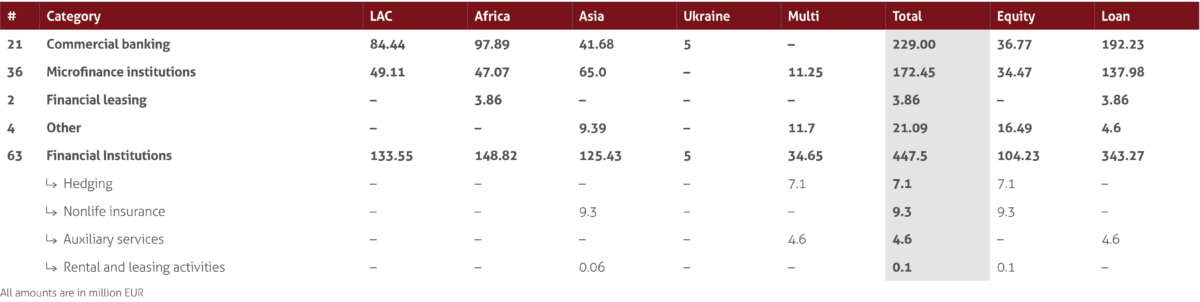
In terms of signed investments in financial institutions, BIO signed 8 such investments, totalling €69.25 M.

Example – Amartha
In 2025, BIO extended a $15M loan as part of an IFC‑led facility to support the expansion of Amartha, an Indonesian fintech‑enabled microfinance platform providing productive loans to unbanked women in rural areas. It connects 1.5 million female borrowers with institutional and retail lenders across 92,000 villages, supported by digital credit scoring and a hybrid microfinance–P2P model. The investment strengthens financial inclusion, boosts rural entrepreneurship, and supports the growth of women‑led micro‑businesses in Indonesia. Through its investment in Amartha, BIO expects to contribute to its SITs on Job creation (1), Microfinance (3), Inclusive Businesses (5) and Gender (6). More info on the investment here.

Example - Banco Azul De El Salvador
In 2024, BIO provided a $15 M loan to Banco Azul de El Salvador to expand its lending to small and medium‑sized enterprises and to strengthen responsible banking practices. In 2025, BIO complemented this with targeted support through the BDSF, including $12,543 to help the bank prepare for certification in international client protection standards and $28,279 to develop a climate strategy. This support was designed to help Banco Azul understand its exposure to climate‑related risks, define priorities for climate‑aligned lending, and build the internal capacity needed to gradually expand green finance. Together, these interventions reinforce the bank’s ability to offer responsible, transparent, and climate‑aware financial services in El Salvador. BIO expects it to contribute to its SITs on SME Finance (2), Gender (6) and Climate Finance (7).
2025 investments in financial institutions


BIO has granted a EUR 1.5 M loan to ACEP Group, a pan-African microfinance institution operating in Burkina Faso, Niger, Madagascar and Cameroon.

BIO has granted a USD 15 M loan to Amartha, an Indonesian microfinance fintech platform.

BIO has granted a USD 15M loan to Banco Atlántida El Salvador (BAES), specialized on SME financing in the Salvadorian market.

BIO has granted a USD 15 M loan to Banco Multiple ADEMI, a Dominican multiple bank with a strong focus on MSME financing

BIO has invested an additional USD 1.5 M in equity in Banco Popular, a Honduran microfinance institution.

BIO has invested EU 20M in equity in Coris Holding, a leading and top performing banking group in Francophone West Africa.

BIO has provided a €3 M loan to Vital Finance Benin, one of the country's leading microfinance institutions.